
A battle worth fighting
Well, it sounded a whole lot more interesting than it really is.
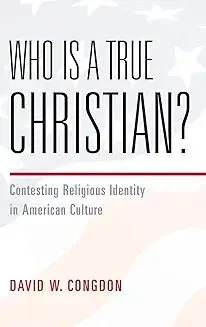
I’m speaking of the book Who Is a True Christian? by David W. Congdon.
I read a review of it in Christian Century and for some reason that now escapes me, I was intrigued.
I sent a copy of the review to Hal Knight, a professor at Saint Paul School of Theology in Leawood and longtime friend and mentor, to see whether he thought it might be a candidate for our reading group.
Based on the review, he was not impressed by the book, but he asked me to let him know what I thought when I read it.
So this is my message to Hal – and to you, too, if you are inclined.
Initially, I found the book very hard to read. There are reasons I don’t read much raw theology these days, and this book clicks most of the boxes.
But I kept reading stubbornly, thinking it would get better. It did, somewhat, until the end, when it crashed and burned.
Congdon ought to be a good read. He’s senior editor at the University Press of Kansas, and he teaches at the University of Dubuque Theological Seminary.
I have two complaints.
First, he writes for an airy academic audience. He is capable of writing a simple declarative sentence, and even a complex declarative sentence, and he proves this capability several times.
However, most of his sentences suffer compound fracture. They are overly complex. They have far too many dependent and sub-dependent clauses. Too often his sentences require a second or even third read for me to figure out what he’s trying to say. And then I basically shrug and think, “Well, why didn’t he just say that outright?”
I know that it is possible to be precise while being concise but density reigns here. I don’t think it needs to reign anywhere.
Second, his conclusion turns out to be kinda wonky.
For most of the book he appears (at least to me) to oppose orthodoxy of belief because (he says) it always turns out to be right wing and oppressive. (Think Christian nationalism.) But at the end he declares that it is impossible for anybody to define the essence of Christian faith, so everybody ought to be free to believe whatever they want.
In place of orthodoxy he calls for “polydoxy,” which is essentially anything goes. Or, as he puts it: “everyone must embrace heresy.”
I don’t buy it. It seems to me that if at least some of us can’t agree on what we’re about as Christians, then we have nothing to say to the world, so we might as well shut up.
I do not think that’s what Jesus had in mind.