
A Taste of the Faithful Life

Archive
- October 2026
- August 2026
- July 2026
- June 2026
- May 2026
- April 2026
- March 2026
- February 2026
- December 2025
- November 2025
- October 2025
- June 2025
- May 2025
- April 2025
- February 2025
- January 2025
- December 2024
- October 2024
- September 2024
- August 2024
- July 2024
- June 2024
- May 2024
- April 2024
- March 2024
- February 2024
- January 2024
- December 2023
- October 2023
- August 2023
- July 2023
- June 2023
- March 2023
- February 2023
- October 2022
- August 2022
- July 2022
- June 2022
- May 2022
- April 2022
- March 2022
- February 2022
- January 2022
- November 2021
- September 2021
- August 2021
- July 2021
- June 2021
- May 2021
- April 2021
- March 2021
- February 2021
- January 2021
- December 2020
- November 2020
- October 2020
- September 2020
- August 2020
- July 2020
- June 2020
- May 2020
- April 2020
- March 2020
- February 2020
- January 2020
- December 2019
- November 2019
- October 2019
- September 2019
- August 2019
- July 2019
Chaos and cruelty
Chaos and cruelty are hallmarks of the trump regime.
Chaos and cruelty. These are the hallmarks of the trump regime.
They are not accidental. They are part of a calculated plan.
Chaos keeps your name “in the news” every hour of every day. That makes everything you do appear more important, no matter how insignificant it really is.
The more cruel the outcome, the better. That tells everyone you mean business, and who knows who might be the next target – maybe even you!
The latest example is the plan to livestream an execution by military firing squad.
Many details remain uncertain. Will there be multiple camera angles and closeups? What about instant replay? Slow motion with lots of blood spatter, like in the movies? High-def sound of the bullets hitting?
So many questions unresolved. Chaos is good!
OK, many religious and political leaders around the globe have condemned the plan as barbaric, and the outcry may cause the ringleaders to walk back their plan. But still, it’s chaos and it’s cruel – it can hardly be beat!
Think of all the ink that’s been spilled about this already! It’s super easy to see who’s on your side and who isn’t! Who needs elections when you’ve got issues like this to sort out your friends and your enemies?
* * * * *
Speaking of cruel chaos and an enemies list, how about sending federal agents on a predawn raid of one of your most frequent critics just a few weeks before she stands for re-election? Likely, Rep. Ilhan Omar will survive this atrocity, maybe even benefit from it – especially if trump comes up with more lies about how Somalians love to eat your pets for lunch.
* * * * *
Of trump’s support of “Doc” Marshall and his lies about Adam Hamilton and Resurrection: A United Methodist Church I will say more later.
* * * * *
Here’s another example of chaos and cruelty.
The other day, in the midst of a long and mostly incoherent speech, trump appeared (to some anyway) to say that it would be OK for Iran to bomb a couple cities in California.
That’s not at all what he meant, supporters say.
Yes, it was.
The idea is to speak so incoherently that nobody can tell exactly what you meant to say, and then when certain people, especially those in the press, pick up on one interpretation, you can denounce them as traitorous leftists. All the while, of course, your supporters know exactly what you meant to say – at least after your own press office sorts it out.
Just follow these threads of rhetoric, they say. Don’t be misled by those who follow different threads to different conclusions. This is the only logical interpretation.
Meantime, our former friends and allies around the world just shake their heads sadly and wonder how soon trump will complete his betrayal of Ukraine and move closer to making the U.S. a new state in the Russian empire.
* * * * *
Monday, Oct. 12, was Indigenous People's Day. It used to have a different name. Think of a bad movie based on a novel by Philip Roth, both titled “Goodbye Columbus.”
* * * * *
This may be the most negative book review I’ve ever written.
The book is Living With Freddie: How a Dog Taught Me to Be Human, by Anna Heyward.
Freddie is a second-hand 8-year-old Italian greyhound that the author tried to live with for several years and finally gave up. The last she saw of him was him panicking as he was being driven away by his new owner. She knows nothing of how he fared afterward.
She was perhaps uniquely unsuited to live with him in the first place. Freddie was an overbred (and inbred) toy lapdog who had huge problems with separation anxiety and demanded near constant attention that she simply could not provide.
As to how Freddie taught her to be human I cannot say because she shows little evidence of any progress on that front. She later got another dog that appears to be a better fit. I’m happy for her and her new dog. I worry about Freddie.
Life with any animal can be difficult, and neither human nor animal always gets it right. I suspect most dog and cat owners have their own horror stories to tell, but despite the struggles many of these stories have more or less happy endings. I wish this one had both a better story and a better ending.
Chaos & cruelty
Chaos and cruelty are hallmarks of the trump regime. Both are intentional.
Chaos and cruelty. These are the hallmarks of the trump regime.
They are not accidental. They are part of a calculated plan.
Chaos keeps your name “in the news” every hour of every day. That makes everything you do appear more important, no matter how insignificant it really is.
The more cruel the outcome, the better. That tells everyone you mean business, and who knows who might be the next target – maybe even you!
The latest example is the plan to livestream an execution by military firing squad.
Many details remain uncertain. Will there be multiple camera angles and closeups? What about instant replay? Slow motion with lots of blood spatter, like in the movies? High-def sound of the bullets hitting?
So many questions unresolved. Chaos is good!
OK, many religious and political leaders around the globe have condemned the plan as barbaric, and the outcry may cause the ringleaders to walk back their plan. But still, it’s chaos and it’s cruel – it can hardly be beat!
Think of all the ink that’s been spilled about this already! It’s super easy to see who’s on your side and who isn’t! Who needs elections when you’ve got issues like this to sort out your friends and your enemies?
* * * * *
Speaking of cruel chaos and an enemies list, how about sending federal agents on a predawn raid of one of your most frequent critics just a few weeks before she stands for re-election? Likely, Rep. Ilhan Omar will survive this atrocity, maybe even benefit from it – especially if trump comes up with more lies about how Somalians love to eat your pets for lunch.
* * * * *
Of trump’s support of “Doc” Marshall and his lies about Adam Hamilton and Resurrection: A United Methodist Church I will say more later.
* * * * *
Here’s another example of chaos and cruelty.
The other day, in the midst of a long and mostly incoherent speech, trump appeared (to some anyway) to say that it would be OK for Iran to bomb a couple cities in California.
That’s not at all what he meant, supporters say.
Yes, it was.
The idea is to speak so incoherently that nobody can tell exactly what you mean to say, and then when certain people, especially those in the press, pick up on one interpretation, you can denounce them as traitorous leftists. All the while, of course, your supporters know exactly what you meant to say – at least after your own press office sorts it out.
Just follow these threads of rhetoric, they say. Don’t be misled by those who follow different threads to different conclusions. This is the only logical interpretation.
Meantime, our former friends and allies around the world just shake their heads sadly and wonder how soon trump will complete his betrayal of Ukraine and move closer to making the U.S. a new state in the Russian empire.
* * * * *
Monday, Oct. 12, was Indigenous People's Day. It used to have a different name. Think of a bad movie based on a novel by Philip Roth, both titled “Goodbye Columbus.”
* * * * *
This may be the most negative book review I’ve ever written.
The book is Living With Freddie: How a Dog Taught Me to Be Human, by Anna Heyward.
Freddie is a second-hand 8-year-old Italian greyhound that the author tried to live with for several years and finally gave up. The last she saw of him was him panicking as he was being driven away by his new owner. She knows nothing of how he fared afterward.
She was perhaps uniquely unsuited to live with him in the first place. Freddie was an overbred (and inbred) toy lapdog who had huge problems with separation anxiety and demanded near constant attention that she simply could not provide.
As to how Freddie taught her to be human I cannot say because she shows little evidence of any progress on that front. She later got another dog that appears to be a better fit. I’m happy for her and her new dog. I worry about Freddie.
Life with any animal can be difficult, and neither human nor animal always gets it right. I suspect most dog and cat owners have their own horror stories to tell. Despite the struggles, many of these stories have more or less happy endings. I wish this one had both a better story and a better ending.
Good election news

It is good news that the Rev. Adam Hamilton led a crowded field for the Democratic nomination for Roger Marshall’s Senate seat. Now, of course, he has to defeat Marshall in the fall election.
That will be a lot harder, if only because voting Republican is a default action for many Kansas voters.
You can see that tendency reflected in the vote for Ty (trump mini-me) Masterson for Kansas governor and for Mark (trump mini-mini-me) Alford for the U.S. House.
Happily, though, the awful proposal to elect Supreme Court justices went down in flames – testifying that Kansas voters are capable of discernment. They know when they are being scammed, though they continue to re-elect some of the worse scammers.
Missouri voters also turned down terrible proposals to do away with the state income tax and restrict the right of voters to initiate change.
Speaking of scams, I was distressed to read a Religion News Service story captioned “As clergy run as Democrats, Republicans question their faith.”
Yep, Hamilton and others like him are being called “PINOS” – or “Pastors in Name Only.” Seems that if you’re not a bona-fide “evangelical” – a Republican, that is – then you can’t possibly qualify as a pastor, let alone a Christian.
This is sickening, but it’s the way far too many appear to think, if you can call such ruminations thinking.
I guess we’ll see far worse before the election season is over. Meantime, for a short time, you can watch broadcast TV without being bombarded by political lies.
A visceral ‘Odyssey’
“The Odyssey” is an almost overwhelming visceral experience in IMAX projection.
But there’s more to it than it.
It’s also a cultural landmark that says a lot about who we are.
More on Blog page.
So much has already been written about Christopher Nolan’s movie “The Odyssey” that I hesitate to add to the conversation. Nevertheless…
I found it to be a very visceral experience. That’s partly because I saw it in IMAX, which tends to be overwhelming visually, and partly because of its powerful – and often quite disturbing – visuals. I haven’t slept well since seeing it, and when I’m lying awake wondering why I’m awake, I keep seeing certain images again and again.
Before I continue, let me repeat the gist of a recent Facebook post.
It is sadly amusing to read so many reviews of the movie that criticize Nolan for presenting Homer's epic in terms of 2026 sensibilities.
What do these self-appointed cultural “purists” expect -- that he would try to interpret Homer in terms an Elizabethan might appreciate, or perhaps try the phony Mel Gibson ploy of presenting it in ersatz ancient languages (a la “The Passion of the Christ”)?
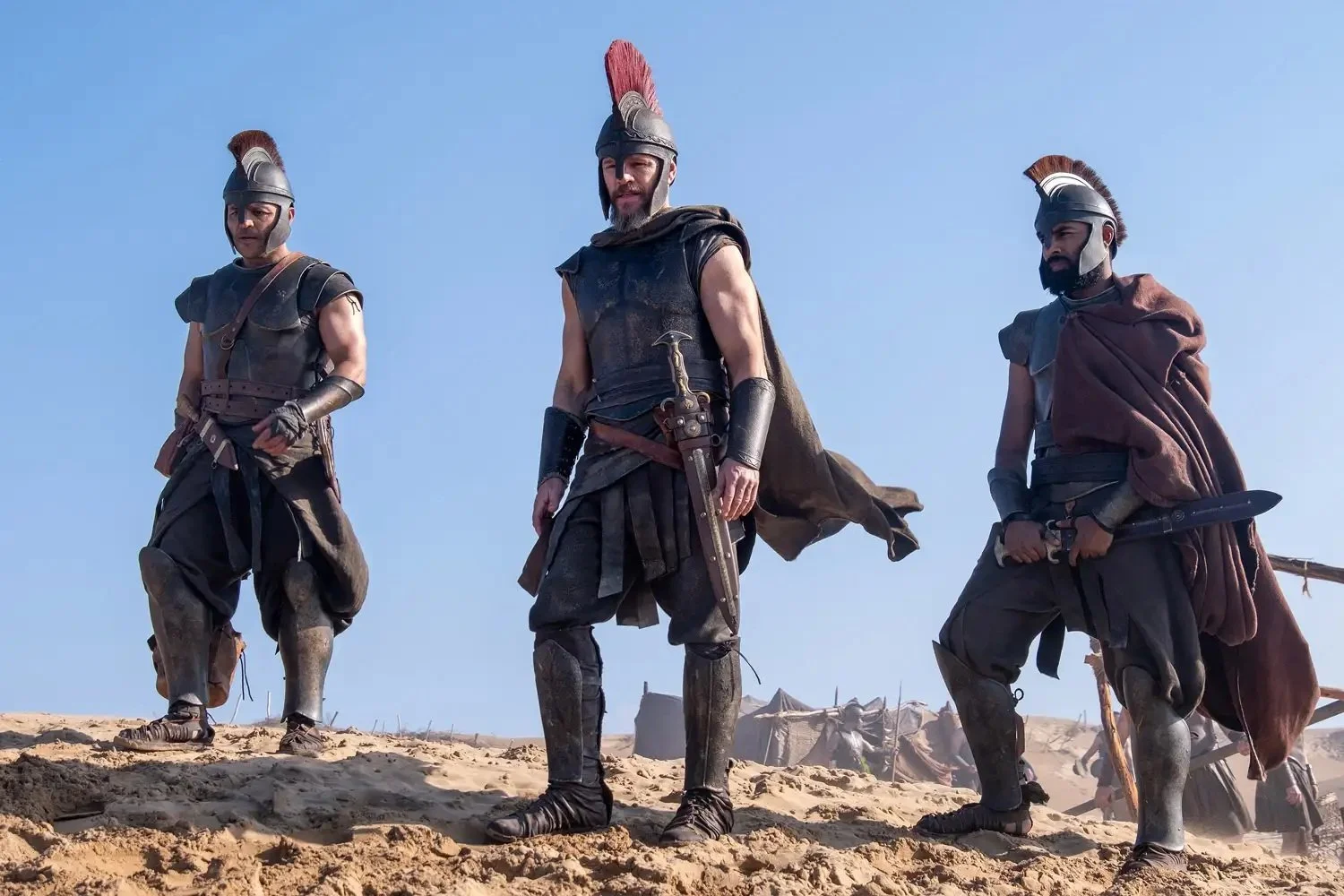
As to the racists who complain about the casting of non-white actresses as Helen of Troy and the goddess Athena: Racists will be racists. Who do you expect them to be?
Two of the upsetting scenes involve the giant cyclops trapping Odysseus and his men in a cave, and the sorceress Circe turning hungry sailors into pigs. The first is terrifying, the second almost sickening. Also memorable is the scene where Odysseus watches helplessly while giant armored warriors overturn one of his ships and massacre its crew.
Though his reunion with wife Penelope is rewarding, far more moving for me is the brief sequence where he touches his old dog, Argos, who has been waiting faithfully 20 years for his master to return, and we see a tail briefly wagging before the dog dies.
Why does Odysseus encounter such frightening obstacles to his return? It is explained that he violated xenia, the ancient law of hospitality, which is once or twice confusingly (and I think erroneously) called “Zeus’s law.”
This law is that you should always offer hospitality to anyone who shows up at your door because he might be one of the gods in disguise. This principle was widely known in the ancient world and was given exalted status in early Christianity. (Note Hebrews 13:2 and Acts 14:11-12.) But it’s a slippery concept.
The abduction of Helen was a violation of xenia. So was the deception of the Trojan Horse, an idea of Odysseus’ that led to the defeat and sacking of Troy. But the mayhem of Troy’s sacking was simply how ancient wars were fought and was not, apparently, a violation of xenia. The violation was in the deception that led to the sacking. Or so I understand.
Odysseus is haunted throughout the movie by thoughts that he violated xenia. So at the end, through reunited with Penelope, he goes into voluntary exile, leaving his son Telemachus to rule Ithaca.
A couple more quick thoughts:
· The movie probably will win an Oscar for its editing (especially brilliantly shown in the Circe sequence.)
· I thought the Hades sequence was muddled, at best.
· Yes, Nolan likes his movies loud, but AMC theaters are always too loud, if you ask me. I guess the volume is for the benefit of those who like to sit in the back row, while I prefer sitting much closer to the screen – even a giant IMAX screen.
Now I’ve got to make Linda suffer through (or hide to avoid) two previous screen versions of the tale: “Ulysses,” starring Kirk Douglas (1954); and “The Odyssey,” starring Armand Asante (1997) – but wait, featuring Vanessa Williams as the nymph Calypso. What must our noisy racists make of that!
Where true bias lies
The firing of Scott Pelley from “60 Minutes” illustrates how deeply true fake news dispensers have infiltrated our news media.
I wrote the chair of the Federal Communications Commission about it. I do not expect a reply.
More on Blogs page.
I recently sent this letter to Brendan Carr, chair of the Federal Communications Commission. It is especially timely because of the CBS firing of Scott Pelley for insubordination – otherwise known as standing up for truth, justice, and the American way.
Mr. Carr,
It seems that you think it is your proper role as chair of the FCC to force broadcasters to march lock-step to the Trump regime’s political and cultural agenda. I tell you, it is not.
You recently wrote: “Broadcasters that are running hoaxes and news distortions — also known as the fake news — have a chance now to correct course before their license renewals come up.”
“The law is clear. Broadcasters must operate in the public interest, and they will lose their licenses if they do not.”
No, the law is clear: You cannot force broadcasters to do your will, or Trump’s will either. It is not in the public interest, convenience or necessity for broadcasters to report only what and how you and Trump want it reported.
What you and Trump define as “fake news” is, as everyone else knows, real news. What is fake are Trump’s attempts to distort what is happening to his own personal interest. What also is fake are your attempts to bully broadcasters into compliance.
If it were your proper role to determine what is “fake” and what is real, you would have jumped all over Fox “News” and Newsmax and other outlets long ago. But you haven’t, have you? No, because they know who and what they really serve, and it certainly isn’t the American public.
Your threats are so obviously biased that any case you might bring against any broadcaster would soon be ruled invalid in the courts on First Amendment grounds, if not the longstanding rules governing the FCC.
You and your buddies have stolen funding from NPR, neutralized the Washington Post, neutered CBS News and are now looking to destroy the credibility of any unit connected to Paramount. You are well on your way to creating a propaganda empire. But you will not prevail in the end because might does not make right; it only creates more victims
I do not expect this letter to sway your thinking in the slightest. But you must know that millions of Americans do not share your fascination with fascism, and your efforts to force your opinions on us will be vigorously opposed and ultimately defeated.
Your latest efforts to silence all critics by threatening the licenses of ABC stations if Jimmy Kimmel is not fired are both ridiculous and unconstitutional. But that appears to be par for the course for the dangerous game you are playing to please your boss. You ought to be serving the American people instead.
(signed)
James A. Hopwood
It’s already been rejected by Abingdon Press, the United Methodist publishing house. It says it has other similar works already in process. I’ve always given Abingdon the right of first refusal on all my book proposals, and I’ve always been rejected. I think it’s time to put some other publisher at the top of my query list.
* * * * *
Three KU profs are under fire for allegedly faking their Native American ancestry. Kansas City Star columnist Yvette Walker confesses that her family also had unconfirmed stories about a Blackfoot ancestor.
“For as long as I can remember, I believed I had Native ethnicity,” she writes. “I even thought I knew which tribe I supposedly belonged to because it was a part of my family’s oral history.” To test the family memory, she took a Family DNA test. Turns out family oral history was wrong.
My family also has an oral tradition that a woman several generations back was Native American. Not exactly the classic “Cherokee princess” story, but close enough.
I’m about all who’s left to carry on family oral tradition, and my searches on Ancestry.com have found nothing to corroborate this story. I once assumed that it was because racists in my family conveniently “forgot” about the Indian ancestor until it became more socially acceptable to claim her, but by then all details were lost in time. Maybe it was a myth all along.
I did have an uncle who was Native. He married into the family. Sadly, he died relatively young as an alcoholic.
Whether I have any “Indian blood” in me matters less than how I view and treat Native Americans. Since childhood I have been fascinated by various Indian cultures. The more I learn about the genocide campaign against Native tribes, the more I am appalled by the tragedy of racism.
If you’re interested in learning more, I suggest reading The Rediscovery of America by Ned Blackhawk. Actually, I wasn’t capable of reading all of it. I had to skim parts. It’s well written, but many parts will simply break your heart.
* * * * *
Back to school time nears already. Where did the summer go? Weren’t summers longer back in the “good old days”? Granted, summer child care can be a chore for busy parents. Maybe advancing age fools me on the passage of time, but I wonder if today’s kids suspect they’re being cheated of days in the sun.
Linda and I just bought school supplies for a Spring Hill 9th grader. We deliberately did not keep track of how much it cost. I can’t imagine the expense of having two kids in high school right now, let alone one. Tell me: Why does any high schooler need five two-inch three-ring binders?